
 View full size
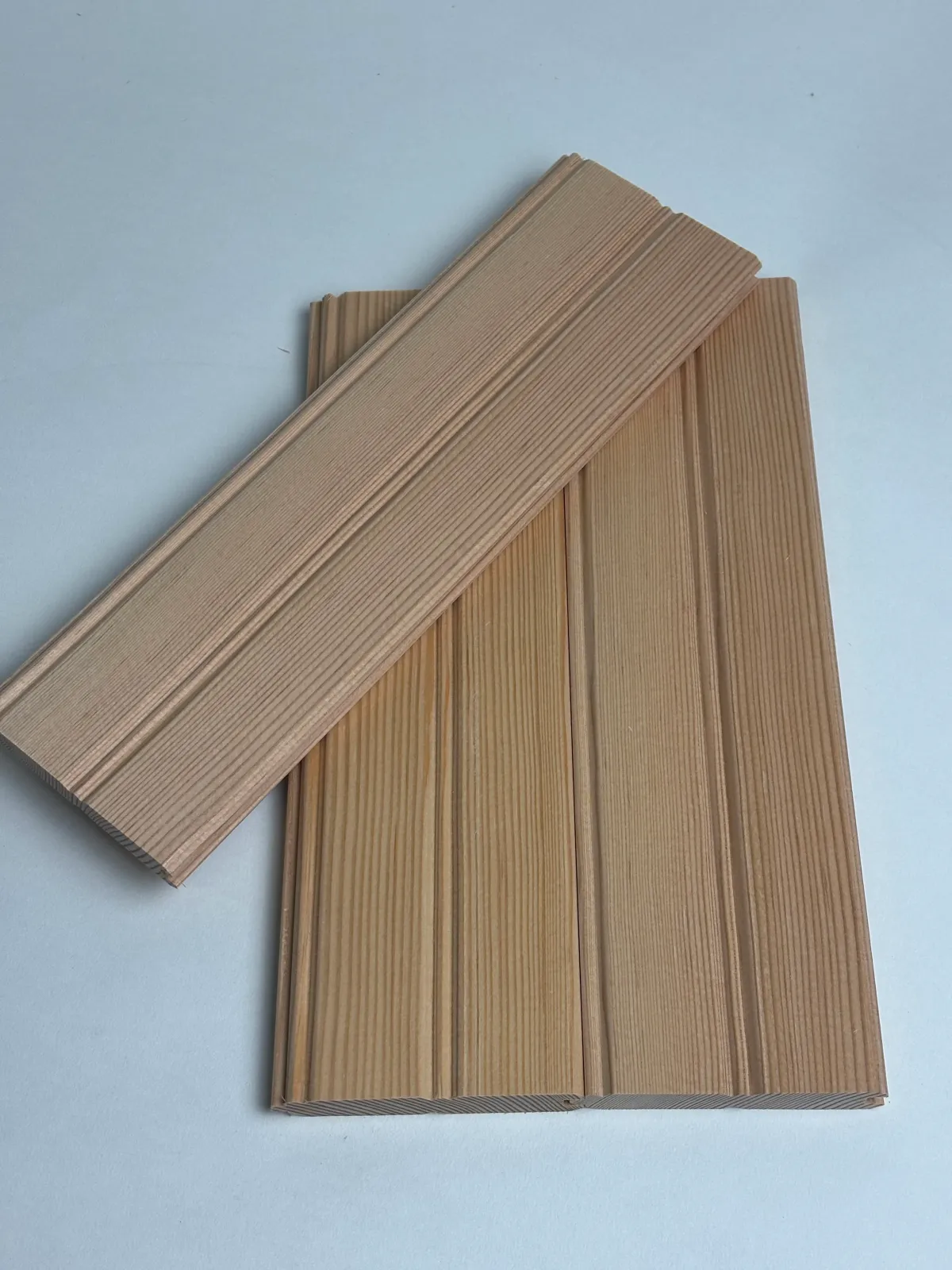
Douglas Fir 5/8x6 CVG Regular ECB Ceiling
Douglas Fir 5/8x6 · CVG Regular · ECB Ceiling Pattern · 6–16′ or longer lengths. Our Clear grade Doug Fir is pulled for export quality 85/15 fine grain.
5/8x6 CVG ECB Ceiling Pattern covers 5.125″ per lineal foot · 0.5 BF per lineal foot.
| Length | Board | $/LF | $/MBF |
|---|---|---|---|
| 6' | $21.60 | $3.60 | $7,200 |
| 7' | $25.20 | $3.60 | $7,200 |
| 8' | $28.80 | $3.60 | $7,200 |
| 9' | $32.40 | $3.60 | $7,200 |
| 10' | $36.00 | $3.60 | $7,200 |
| 11' | $39.60 | $3.60 | $7,200 |
| 12' | $43.20 | $3.60 | $7,200 |
| 13' | $46.80 | $3.60 | $7,200 |
| 14' | $50.40 | $3.60 | $7,200 |
| 15' | $54.00 | $3.60 | $7,200 |
| 16' | $57.60 | $3.60 | $7,200 |
| 17' | $61.20 | $3.60 | $7,200 |
| 18' | $64.80 | $3.60 | $7,200 |
| 19' | $68.40 | $3.60 | $7,200 |
| 20' | $72.00 | $3.60 | $7,200 |
| Length | 6' | 7' | 8' | 9' | 10' | 11' | 12' | 13' | 14' | 15' | 16' | 17' | 18' | 19' | 20' |
|---|---|---|---|---|---|---|---|---|---|---|---|---|---|---|---|
| Board | $21.60 | $25.20 | $28.80 | $32.40 | $36.00 | $39.60 | $43.20 | $46.80 | $50.40 | $54.00 | $57.60 | $61.20 | $64.80 | $68.40 | $72.00 |
| $/LF | $3.60 | $3.60 | $3.60 | $3.60 | $3.60 | $3.60 | $3.60 | $3.60 | $3.60 | $3.60 | $3.60 | $3.60 | $3.60 | $3.60 | $3.60 |
| $/MBF | $7,200 | $7,200 | $7,200 | $7,200 | $7,200 | $7,200 | $7,200 | $7,200 | $7,200 | $7,200 | $7,200 | $7,200 | $7,200 | $7,200 | $7,200 |
Need help with a takeoff? Request a quoteand we'll build the tally for you.
Douglas Fir 5/8x6 CVG Regular ECB Ceiling — Douglas Fir, CVG Regular. 5/8″ × 6″ finished, tallied on a 1″ nominal count. Available in 6–16′ or longer lengths. The equivalent price per lineal foot is shown above. Our Clear grade Doug Fir is pulled for export quality 85/15 fine grain.
About Douglas Fir
Full Douglas Fir profile →Douglas fir (Pseudotsuga menziesii) is widely regarded as the most economically important softwood in the world, and it carries the highest strength-to-weight ratio of any wood species on the planet.
The name honors two rival botanists. David Douglas, a Scot, sent the first seeds east from the Pacific Northwest in 1826, while the scientific name — Pseudotsuga menziesii, literally "false hemlock" — credits Archibald Menzies, who documented the tree on Vancouver Island in 1791. It spent some seventy years being reassigned among the pines, spruces, firs and hemlocks before finally earning a genus of its own in 1867.
It is a genuine oddity among conifers. Nearly every other member of the pine family carries twelve pairs of chromosomes; Douglas fir carries thirteen. Two subspecies split the West — the coastal variety that dominates the wet old-growth forests from British Columbia south, and the hardier Rocky Mountain variety that ranges all the way to central Mexico. Left undisturbed, a coastal tree can top 300 feet, measure well over twelve feet across at the base, and live 500 to 1,000 years.
The wood is what earns the reputation. Heartwood runs a warm orange-red to reddish brown against pale, yellowish sapwood, with a straight, pronounced grain and a medium-to-coarse texture. Vertical-grain (quartersawn) boards show tight, parallel lines and are the pinnacle of the species for exposed finish work; mixed-grain boards show a bolder cathedral figure at a friendlier price. Both take stain, paint and clear finishes readily.
Grain count is everything with Douglas fir. Dense old-growth logs — many of them 300 to 400 years old and recovered as salvage after fire or windstorm — yield tight, fine-ringed lumber that faster-growing second growth simply cannot match. That density drives both strength and stability, which is why the finest vertical grain is fought over by export markets and used for structural timbers and clear finish alike. Peak old-growth harvest was back in the 1980s, and the truly fine fiber has been getting scarcer every year since.
Douglas fir does nearly everything: FOHC timbers, posts and beams for timber framing; beaded ceiling and tongue-and-groove paneling; wainscoting and trim; porch and interior flooring. We stock kiln-dried clear vertical-grain flooring in 1x4 and 1x6.
- Color
- Heartwood is Golden-yellow to orange-red. Sapwood is light tan to light yellow.
- Grain
- Straight to wavy
- Texture
- Coarse to medium
- Durability
- Heartwood is rated moderately durable in regard to decay.
- Working
- Workability is rated as easy.
- Drying
- Rated as fairly easy to dry, with slight chance of splitting and checking
- Common uses
- Decking, flooring, construction, decorative veneers, furniture, joists, joinery, sub-flooring, plywood, wharf construction
- Origin
- Western US, Oregon, Washington, California; Western Canada, British Columbia
- Botanical family
- Pinaceae
- Also known as
- Pseudotsuga menziesii, Blue Douglas-fir, British Columbia pine, British Colubian pine, Coast Douglas-fir, Colorado Douglas-fir, Colorado Pino real, Colorado real, Columbian Pine, Douglas spruce, Inland Douglas-fir, Interior Douglas-fir, Oregon Douglas-fir, Oregon pine, Puget Sound pine, Red fir, Rocky Mountain Douglas-fir, Yellow fir
Strength & performance
Compare all decking species →Mechanical properties, benchmarked against Ipe — the tropical-hardwood gold standard.
Specifications
- Material
- Douglas Fir
- Brand
- Ghent Wood Products
- SKU
- DF-ECB-58X6-CVG
- Usage
- Paneling
- Pattern
- ECB Ceiling Pattern
- Grade
- CVG Regular
- Nominal size
- 1 × 6
- Net size (actual)
- 5/8" × 5-3/8", 5-1/8" face
- Sold by
- BF
- Weight
- 1.58 lb
- Availability
- Made to order
Worked with Douglas Fir? Write the first review.
Takes a minute — you'll sign in or create an account so we know reviews come from real customers.